
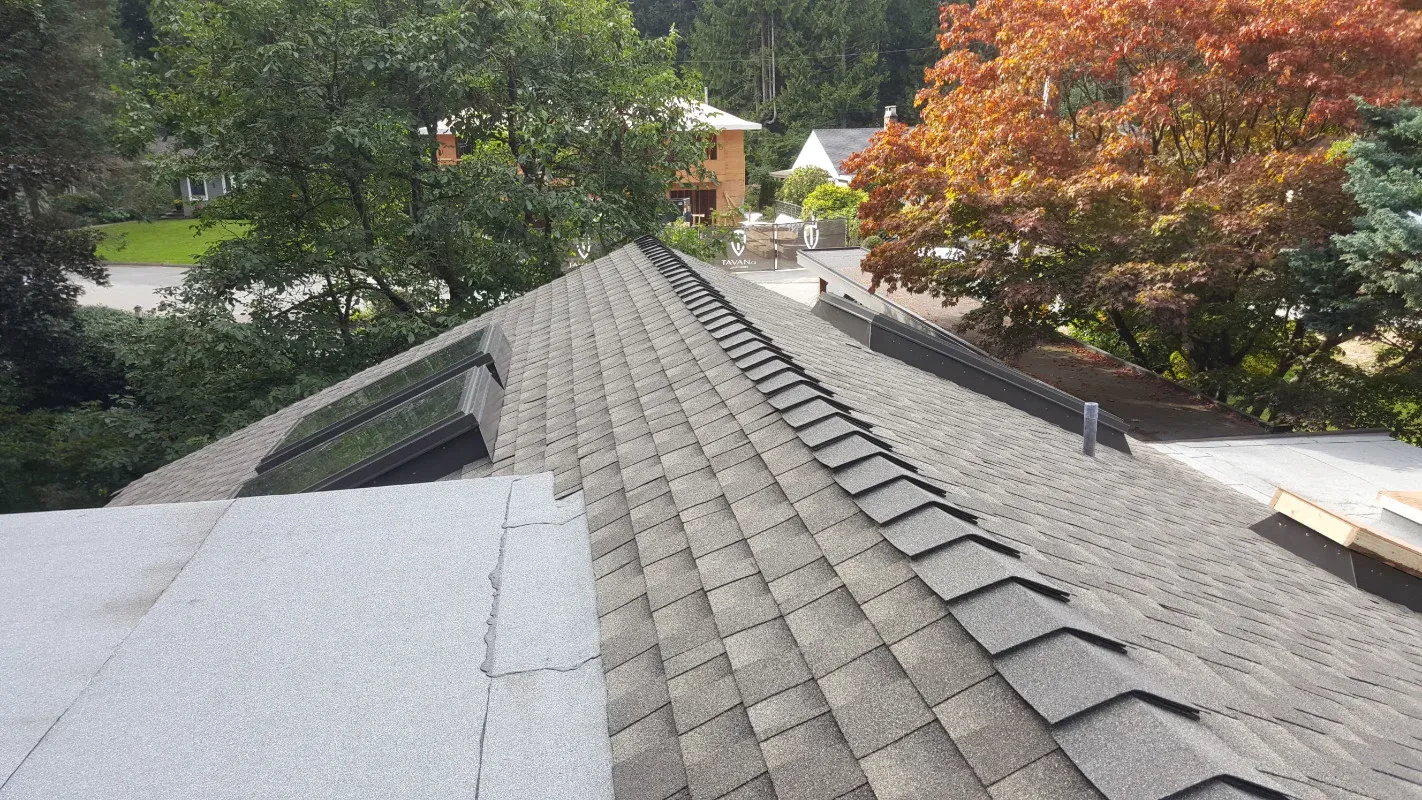
SHINGLE ROOFS
Asphalt Shingle Moss Removal
On an asphalt roof the granules are the wearing surface. Growth is lifted off by hand, worked down the slope, and never driven off with pressure.
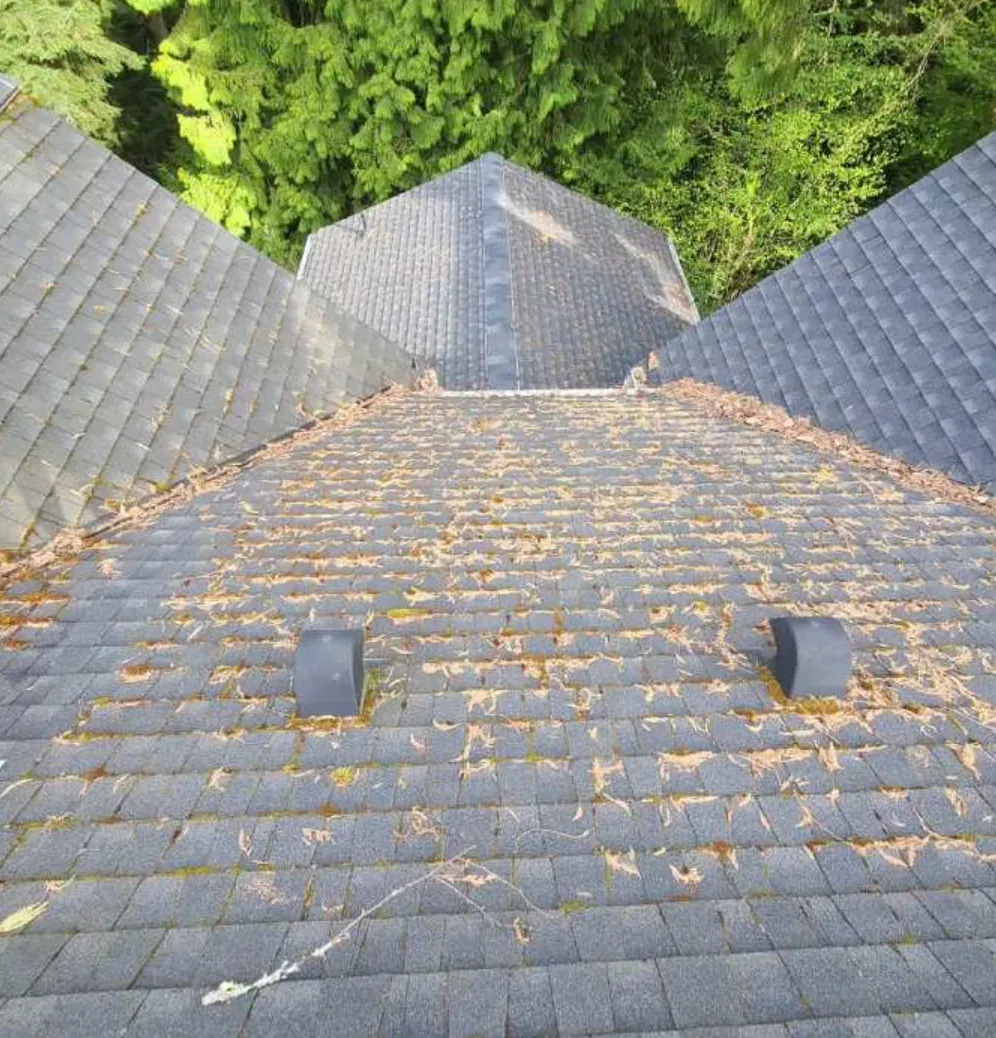
An asphalt shingle is a reinforced mat with a layer of mineral granules fused to the face. Everything about how this roof gets cleared follows from that one fact.
The granules are the roof. They take the sun, they take the rain, and they are the reason the mat underneath lasts decades rather than years. Lose them across a slope and the roof starts ageing at a visibly faster rate, whatever the roof was rated for when it went on.
Why pressure is off the table
Pressure removes granules. Not all of them, not immediately, but enough that the difference shows up in a gutter as a layer of grit and shows up on the roof as a slope that has aged five years in an afternoon.
There is a second problem with it that gets less attention. A shingle roof sheds water because every course overlaps the one below, and that only works in one direction. Water driven uphill goes under the overlap, which is the one place the design does not account for. A pressure wand pointed up a slope does exactly that.
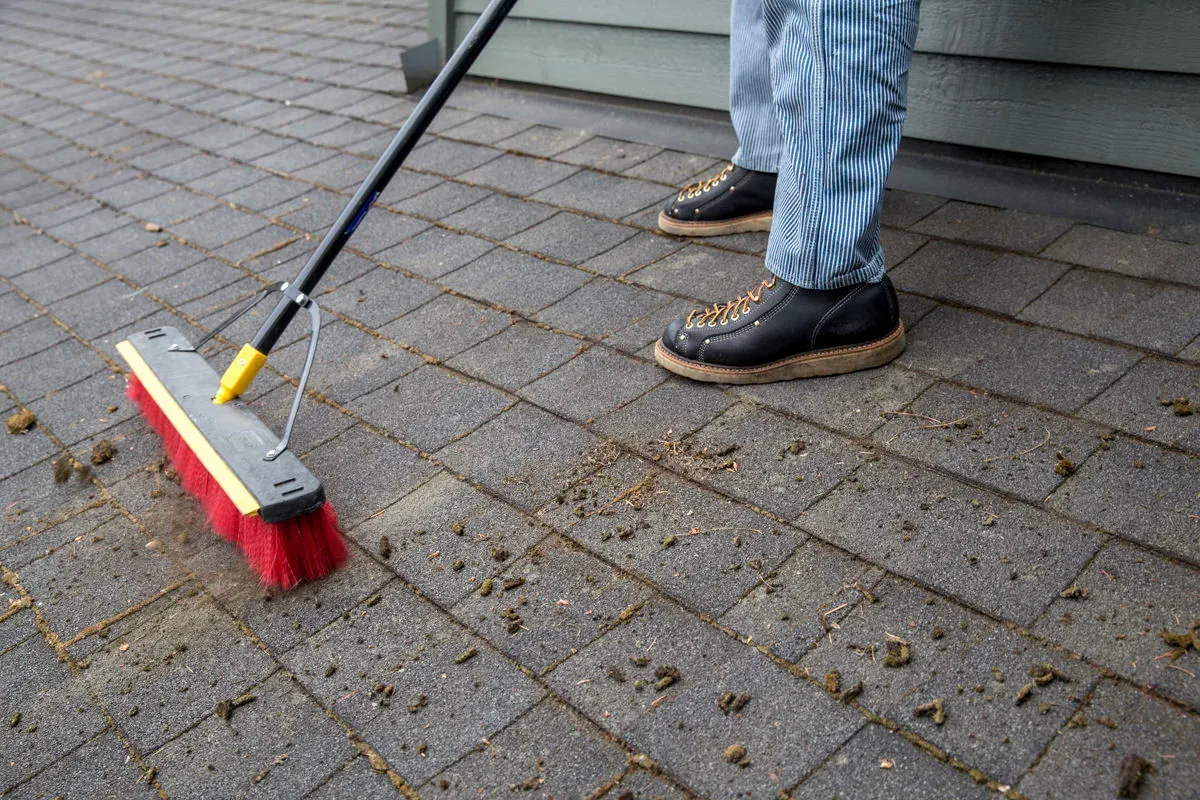
So the growth comes off by hand and by brush, worked down the pitch, lifted off the surface rather than scraped through it. The last trace of it usually stays and weathers off over the next few rainfalls. That is the right trade.
The patches underneath
When a thick mat comes off a shingle roof, it often leaves its own outline behind: an area where the granules are noticeably thinner than the shingle around it.
That is not damage from the cleaning. It is the record of what the growth was doing while it sat there, and it is the single most useful thing a moss visit tells you about the roof. Those patches are where this roof will fail first, and they are almost always on the north and east slopes and in the strip just above the gutter.
We point them out. It is more useful than a clean roof and a silence.
Temperature decides the day
Asphalt is the covering most forgiving of being walked on, and there are two conditions where that stops being true.
Cold shingles are brittle. On a frosty morning a course that would flex under a boot in June will crack instead, and the damage is usually along the edge where it is hardest to see. Hot shingles have the opposite problem: the mat softens, the granule surface scuffs, and a boot leaves a mark that does not go away.
Between those, most of the Saanich year is fine. It does mean that on the coldest and hottest days the work either waits or moves to whichever slope is in the right state, which is one more reason this is booked in the dry stretch rather than squeezed into November.
Where we start
Valleys, then the lowest courses, then the faces.
A valley takes the water off two slopes and concentrates it, so packed growth there does more than growth anywhere else on the roof. The bottom two or three courses sit at the end of every drainage path, shaded by the gutter edge, and stay wet longest. Both are invisible from the ground, which is exactly why they get skipped.
When it is not worth doing
Sometimes the honest answer is to leave it. A roof with shingles curling at the edges, brittle underfoot and shedding granules across whole slopes is at the end of its life, and clearing the moss makes it look better without making it last longer.
If that is what we find, we will tell you, and the estimate stops there.
Different covering? See cedar shake or concrete tile.
Got questions?
Asphalt Shingle — questions
Why will you not pressure wash an asphalt roof?
Because the granules fused to the surface are the roof's wearing layer and its UV protection, and pressure takes them off. The roof looks better for one season and ages faster from then on. Pressure also drives water uphill under the overlap, which is the one direction the roof cannot handle.
There is a bare patch where the moss was. Did you cause it?
No — that patch is why the moss mattered. Growth holds moisture against the surface and the granules under it wear thin while it sits there. Clearing the roof reveals it. We point those patches out rather than say nothing, because they tell you where the roof will go first.
Will the roof be completely clean the day you leave?
The growth will be off, but a faint stain or a trace of root mat often stays and weathers away over the following few rainfalls. Getting that last trace off on the day would mean being harder on the shingle than it is worth.
How old is too old to bother?
If the shingles are curling at the edges, brittle underfoot and losing granules across whole slopes rather than in patches, the roof is near the end and clearing it is tidying rather than protecting. We will say so, and you can put the money toward the replacement instead.
Do the shingles get walked on?
Yes, and asphalt is the covering most forgiving about it — with two exceptions. Cold shingles are brittle and hot ones scuff, so on a frosty morning or a genuinely hot afternoon the work either waits or moves to a different slope.
What about the dark streaks that are not moss?
Those are usually algae, which is flat and runs in vertical streaks down the slope rather than sitting in patches. It comes off far more easily than moss and it is not holding water against the roof in the same way.
Customer reviews
What customers say
“Great customer service, and they came quickly..will be using again for sure”
“They do a great job and provide great customer service! They are always reliable. Thank you,”
Asphalt Shingle in Victoria and the surrounding area
Tell us the address and we will get you a price.